
New hope for PTSD patients
Targeting the neurological root cause of the disease far beyond symptoms

PTSD
A huge unmet global health crisis that demands urgent attention
Post-Traumatic Stress Disorder (PTSD) is a severe mental-health condition triggered by experiencing or witnessing a life-threatening or deeply distressing event.
PTSD Global
prevalence.
people have experienced PTSD at some stage during their lives.
individuals worldwide developing PTSD each year.
*World Health Organization
PTSD’s 4 main categories of symptoms
intrusive
memories
avoidance
negative changes in mood & cognition
Arousal &
Reactivity
Current treatment requires a combination of specialized Psychotherapy and medications. Selective Serotonin Reuptake Inhibitors (SSRIs) like Sertraline (Zoloft) and Paroxetine (Paxil) are the only FDA-approved medications for treating PTSD. These approved medications are used to relief part of the secondary symptoms of PTSD, but do not target the mechanism underlying the core patho-neurobiology of PTSD. Thus, they have limited impact on the sever consequences of the illness.
Indeed, despite the available therapies, significant gaps in patient care remain for most of the patients. Up to 50% of patients do not respond sufficiently to standard SSRIs, and intensive exposure therapies have high dropout rates due to the distress of re-living trauma.
Behind the staggering global statistics of PTSD are hundreds of millions of individuals fighting a deeply distressing daily battle without adequate solution.
The Problem
The memory’s INTENSITY underlines the ROOT cause of PTSD
The excessive intensity of the traumatic fear memory is found to underline the main patho-neurological root cause of PTSD and its related symptoms. At the physiological level PTSD is characterized by:
1
A hyperactive Amygdala; an exaggerated threat response.
2
A hypoactive Medial Prefrontal Cortex; a failure to inhibit or regulate the Amygdala's fear signals.
3
Reduced Hippocampal activation; which impairs the brain's ability to properly contextualize and process memories, leaving the trauma feeling like a present-day threat.
Our Solution
Serentide
Turn the memory VOLUME down
Serentide, a first-in-class disease-modifying peptide specifically reduces the intensity of the traumatic fear memory to normal fear memory levels, through a specific inhibition of the fear memory amplification mechanism, without affecting other, pleasant or aversive memories. Thus, we offer a breakthrough therapeutic approach for specifically treating the underlying patho-neurology of PTSD.
Advantages
Game
changer
treatment
Selective Treatment
Addressing the pathological intensity of the traumatic fear memory directly without affecting normal learning and memory processes.
Gaining Control
The traumatic fear memory is not nullified, but only reduced back to normal fear memory levels, and normal behavioral manifestations, allowing the processing of the traumatic event and its management.
Flexible Use
Because the traumatic fear memory is persistently amplified, Serentide can be administered to PTSD diagnosed patients at any time and even a long time after the traumatic event.
Fits Every Patient
Directly addressing the neurons that compose the traumatic fear memory offers a solution that is independent of the specific activity of different brain regions, thus making the solution resilient to variability between people.
High Compliance
Serentide will be self-administered intranasally for direct brain effect, potentially in combination with Psychotherapy, so high treatment adoption is expected.
Invention & Technology
The Invention
Identifying the memory
amplification mechanism
Our research team discovered a physiological mechanism that amplifies a fear memory and intensifies it to traumatic and pathological levels, thereby enabling the direct targeting of the pathology of the traumatic memory.
Our findings revealed that the excessive intensity of the traumatic memory is mediated by a specific memory amplification mechanism;
the amplification mechanism is selectively induced only on memories that were acquired during extreme traumatic events and thus explains the exceptional intensity of the traumatic memory.
The amplification mechanism is physiologically different from mechanisms underlying normal fear, learning and memory processes and therefore offers a unique pathway for a selective targeting of the traumatic fear memory only.
The fear memory amplification mechanism is mediated by CaMKII phosphorylating Ser831 on the synaptic channel of AMPA receptor, resulting in a twofold increase in the conductance of all the excitatory and inhibitory synaptic channels in and only in the neurons that compose the traumatic fear memory.
The Technology
Homing on the memory’s intensity
is the precise intervention at the core of our new therapeutic approach
is the precise intervention at the core
of our new therapeutic approach
Serentide, a small peptide composed of natural amino acid sequence, is a decoy peptide that interferes specifically with the CaMKII-dependent phosphorylation of Ser831 on the synaptic channel of AMPA receptor, leading to the inhibition of the traumatic fear memory amplification mechanism.
In the preclinical setting, the administration of Serentide attained a significant effect both on the behavioral manifestation of the traumatic fear memory in a PTSD-like fear conditioning mouse model, and on the neuronal expression of the amplification mechanism.
Serentide reduces significantly the freezing time during the retrieval of the traumatic fear memory (reduced by 70%) and completely reverses the amplification mechanism enhancement of the excitatory synapses to normal levels. Moreover, Serentide enables the processing of the traumatic memory and its association with a safer state.
The traumatic fear memory is persistently intense for months after the traumatic event
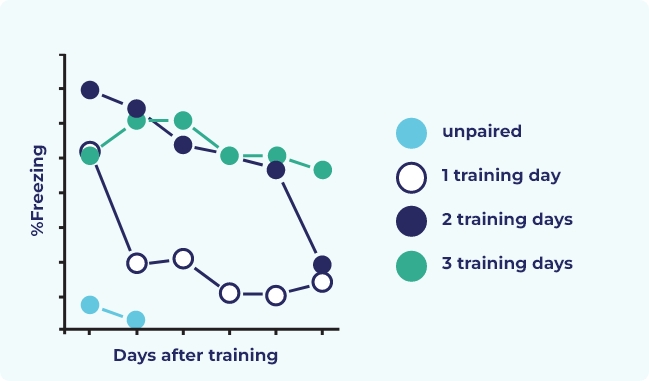
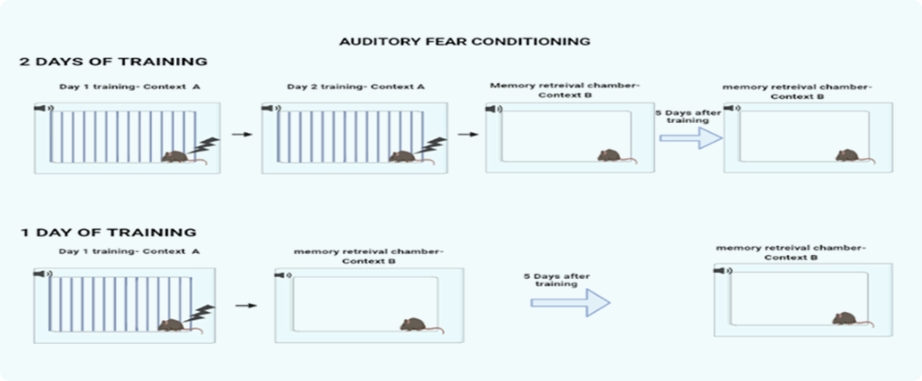
Exposure to repeating traumatic events is known to significantly increase the risk of PTSD.
Indeed, in mice model, while one day of fear conditioning resulted in a fear memory that faded within days, repeating the fear conditioning for several days resulted in a resilient traumatic fear memory that remained intense for months after the traumatic event.
The persistent traumatic fear memory is linked with the induction of the amplification mechanism on the neurons that compose this memory.
Serentide significantly reduces the intensity of the traumatic fear memory back to normal
After treatment, the freezing levels of the traumatic fear memory resembled freezing levels of a normal fear memory, compared to untreated group (control), demonstrating that deleting the amplification mechanism with Serentide transfers the traumatic memory into a normal fear memory.
Serentide enables the processing of the traumatic fear memory and extinction
Exposure to repeating traumatic events is known to significantly increase the risk of PTSD.
Indeed, in mice model, while one day of fear conditioning resulted in a fear memory that faded within days, repeating the fear conditioning for several days resulted in a resilient traumatic fear memory that remained intense for months after the traumatic event.
The persistent traumatic fear memory is linked with the induction of the amplification mechanism on the neurons that compose this memory.
PTSD is not a sign of weakness but a normal reaction to an abnormal event.
Our Vision
We aim to develop Serentide peptide for treating and improving the quality of life of PTSD patients
Serentide will not only and specifically treat the root cause and pathology of PTSD but furthermore will enable patients with a high compliance treatment; to confront, process and manage the traumatic event, in combination with Psychotherapy, without experiencing overwhelming behavioral symptoms and dysfunctions.
The Company
Who are we?
Kailo Pharma Ltd is an early-stage pre-clinical biotech company focusing on the development of Serentide, a first-in-class therapeutic peptide for treating Post Traumatic Stress Disorder (PTSD).
The company was established in March 2026, supported by NGT Healthcare Ltd and the Israeli Innovation Authority, based on scientific discovery and technology originated from Haifa University.
Kailo Pharma is committed to advancing Serentide development and providing new hope to PTSD patients worldwide.
Meet the team

CEO
An experienced biopharmaceutical executive with a track record in leading drug development processes, leading and scaling biotech companies.
Dr. Osnat Ohne
CEO
An experienced biopharmaceutical executive with a track record in leading drug development processes, leading and scaling biotech companies. Prior to Kailo Pharma, she served as the CEO at The National Institute for Biotechnology in the Negev (NIBN) Ltd, an accelerator company of diverse biotechnologies. Previously, served as COO\active-CEO at Tiltan Pharma Ltd, a clinical stage (phase II) company that developed a combination therapy for treating metastatic pancreatic cancer. Prior, she held executive leadership roles at the Global Innovative R&D unit leading innovative drug development projects and at Teva Innovative Venture (TIV) unit at Teva Pharmaceuticals Ltd. Her first leading role was at Peptor Ltd as team leader developing a peptide PKB inhibitor for treating cancer. Currently and over the years, she has been continually serving on the Board of Directors of Biotech companies.
Dr Ohne Holds a PhD in Immunology from Tel-Aviv University.
Back

CSO (computational Neuroscience) and Founder
A neurobiologist at the University of Haifa with a strong background in mathematics, computer science, and computational neuroscience.
Dr. Iris Reuveni
CSO (computational Neuroscience) and Founder
A neurobiologist at the University of Haifa with a strong background in mathematics, computer science, and computational neuroscience. These abilities enabled her to develop the theory of memory amplification and design experiments that support this theory. Motivated by a desire to help individuals with PTSD, she established the foundational concept for a novel peptide therapy aimed at disrupting memory amplification mechanisms. Previously, she acquired experience in the industry in the research labs of IBM, as part of the development of mathematical verification tools.
Back
CSO (Neurobiology) and Founder
A Professor of Neurobiology at the University of Haifa, specializing in the biological foundations of high-skill learning
Prof. Edi Barkai
CSO (Neurobiology) and Founder
A Professor of Neurobiology at the University of Haifa, specializing in the biological foundations of high-skill learning. He holds a B.Sc. and Ph.D. in Biology from Ben-Gurion University and completed his postdoc at Harvard, integrating neurophysiology and computational modeling to study associative memory. He pioneered the discovery that learning involves not only synaptic changes but also long-term shifts in intrinsic neuronal excitability. His lab has published over 50 papers on this topic, training more than 25 Ph.D. students and postdocs. As a former Chair of the Biology Department and Dean of Natural Sciences at Haifa, Prof. Barkai brings deep scientific and leadership experience, making him a key asset in driving this research forward.
Back
CTO (Organic chemistry) and Founder
Prof. Chaim Gilon is an Active Emeritus Professor of Chemistry at the Hebrew University of Jerusalem, a pioneer in peptide drug development and signal transduction therapy.
Prof. Chaim Gilon
CTO (Organic chemistry) and Founder
Prof. Chaim Gilon is an Active Emeritus Professor of Chemistry at the Hebrew University of Jerusalem, a pioneer in peptide drug development and signal transduction therapy. He holds a Ph.D. in Organic Chemistry and completed postdoctoral research in peptide and brain chemistry at UC San Diego and the Salk Institute with Nobel Laureate Prof. Roger Guillemin. He has authored over 300 scientific publications, holds 45+ patents, and has mentored over 50 Ph.D. and postdoctoral students. He is the inventor and co-founder of Peptor Ltd, former head of the Department of Pharmaceutical Engineering at Azrieli College and currently serves as Director of Peptide Technologies at Starget Pharma. He has advised major pharmaceutical companies, including Teva.
Back